Private Label Lipstick Manufacturing: Colour, Formula and Component
A lipstick launch passes three separate approvals before it can be filled: the colour, the formula and the component. Treating them as one decision is the most common reason a timeline slips. The client's published windows run 4 to 8 weeks for ODM on an existing formula and 3 to 6 months for OEM with development, so the approvals have to move together from day one.
Key takeaways
- Three approvals: colour, formula and component.
- The laboratory team is more than 70 people, grouped by product category.
- Published windows: ODM 4 to 8 weeks on an existing formula; OEM 3 to 6 months with development.
- Expect a band of 1,000 to 5,000 units per product, with 500 units sometimes accepted for a debut order.
Three approvals, not one
A shade card signed in a meeting is not an approval. The colour has to survive on the actual base, the base has to hold its shape and feel through the projected shelf life, and the component has to open, twist and click the way the brand promised. Each of those is a separate review with its own sample, and a project that skips one usually repeats the others.
Running the three tracks in parallel is what keeps a launch date realistic. The colour can be matched while the base is still being tuned, and the pack can be sourced while both are in review. The slowest track sets the date, which is why identifying it early matters more than optimising the fast ones.
Approval one: the colour
Colour approval is a match against a reference, not a guess. The client's lipstick page covers the production process and the points to consider when buying lipstick, and the site supports fine-tuning fragrance, texture, skin feel and efficacy during sample preparation. For colour, the useful discipline is to fix the reference and the lighting, then approve on the finished bullet rather than on a laboratory drawdown.
Shade drift is easier to catch across a small set than on a single swatch. Ask for the target shade plus two neighbours on either side, on the real base, so the team can see how the colour behaves at the edge of the range. That single round usually settles a shade that would otherwise come back twice.
Approval two: the formula
The formula decides how the bullet feels and how long it stays usable. Yunmei's laboratory R&D team has more than 70 people, divided into groups by product category, so a lipstick brief is handled by the people who work on lip products rather than a generalist bench. Texture, skin feel and efficacy can all be tuned during the sample stage, which is where the brand should spend its review time.
Stability and compatibility reports take 3 to 6 months and sit on this track, not after it. If the formula needs a new claim or a sensitive-skin note, the supporting test work belongs in the same window. Deciding the final formula late pushes the whole project, because the fill date depends on that report.
Approval three: the component
The component is the part buyers underestimate. A twist mechanism, a cap that clicks and a base that seals all have tolerances, and a pack chosen late may not fit the bullet the formula produced. Component approval covers fit, travel and fill, and it should be tested with the same batch that goes to stability so the results describe the real product.
Pack lead time is a schedule risk in its own right. Where the pack is a stock mould, the timeline is short; a new mould adds weeks. Booking the component before the bulk batch is cheaper than discovering a fit problem after filling.
| Approval | What is signed off | Typical evidence |
|---|---|---|
| Colour | Shade against the reference | Bullet samples on the final base |
| Formula | Texture, feel and claims | Stability and compatibility reports |
| Component | Fit, travel and fill | Filled samples from the bulk batch |
| Content | Weight and label claim | Fill checks on the packed unit |
Worked example: reading the ODM and OEM windows
The chart plots four bars in weeks. ODM runs 4 to 8, so its midpoint is (4 + 8) ÷ 2 = 6 weeks. OEM runs 12 to 26, so its midpoint is (12 + 26) ÷ 2 = 19 weeks. The gap between those midpoints is 19 - 6 = 13 weeks, and the full spread between the fastest ODM and the longest OEM path is 26 - 4 = 22 weeks. Even the shortest OEM case, 12 weeks, sits 4 weeks past the longest ODM case of 8.
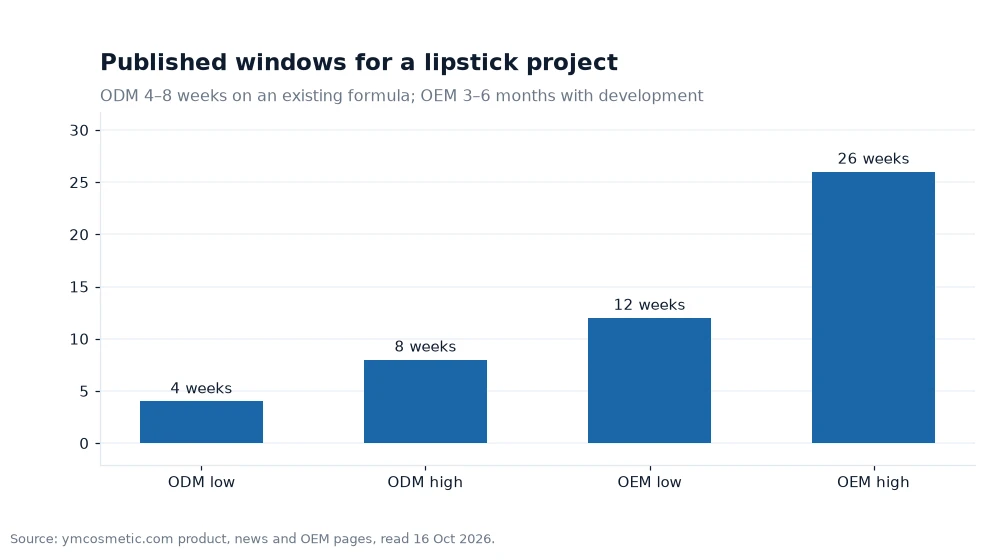
Two numbers carry the decision. The ODM ceiling of 8 weeks is the figure to plan against if a launch is fixed, while the OEM floor of 12 weeks is the earliest a developed formula can realistically be filled. Reading the two together explains why a brand with a hard date usually starts on an existing formula and develops the new one for a later drop.
Samples, stability and the review loop
Samples are the working currency of all three approvals. Years of shade cards are less useful than one bullet you can carry, twist open and wear for a day. The review loop stays short when each round has a named decision attached, so the bench is not sending modified samples without knowing what is being judged.
Stability work runs quietly in the background during those rounds. Because it takes 3 to 6 months, a project that waits for the colour to be perfect before starting it loses that time twice. Starting the report on the most likely formula, and switching later if the shade work forces a change, is usually the faster path.
Writing a brief that keeps three tracks in step
One page can hold the whole project: the reference shade, the texture and claim targets, the pack and its lead time, and the market the claim has to satisfy. With those fixed, the colour, formula and component tracks each know their review criteria and their failure conditions, and the project stops depending on memory.
From there, choose an OEM/ODM partner that can show all three tracks rather than only the formula. A workshop that handles colour, base and pack under one roof removes the handoffs where lipstick projects usually stall. Comparing how an established private label lipstick manufacturers programme documents each approval is a fast way to set your own checklist.
Frequently asked questions
Why are there three approvals instead of one?
Because colour, formula and component fail for different reasons. A shade can match while the base is unstable, and a stable base can still fail if the component does not seal or travel, so each track needs its own sample and its own sign-off.
How long is the ODM path compared with OEM?
ODM is quoted at 4 to 8 weeks on an existing formula, and OEM with development is 3 to 6 months. The midpoints are 6 weeks and 19 weeks, so the gap is 13 weeks and even the shortest OEM case runs 4 weeks past the ODM ceiling.
When should stability testing start?
It should start early, because the reports take 3 to 6 months. Beginning on the most likely formula and switching if the colour work forces a change is usually faster than waiting until the shade is final.
Starting the lipstick brief
Write the three approvals into the brief before you ask for a quote, and name the person who signs each one. That turns a vague launch date into a sequence the factory can plan around, and it makes the ODM or OEM choice a decision rather than a default. The team behind the OEM and ODM services can walk through both paths against the same brief, which is the quickest way to see where your spare weeks are.
Numbers in this article come from the manufacturer's own published pages, read on 16 Oct 2026.[1]